
Let's be honest. Is silicone really that sustainable?
There is an abundance of trendy silicone kids' products around at the moment. Let's be clear: silicone is not completely sustainable. Where it sits on the eco-friendly spectrum is relative.
Yes, it's non-toxic and BPA free, and it's more stable than plastic, so it's less likely to leach chemicals into food. But while the base silicon comes from quartz, a plentiful resource, the hydrocarbons used to make silicone usually come from petroleum or natural gas. Just like plastic, it will never really break down. One positive is that it doesn't crumble into microplastics that harm our wildlife and waterways.
There's nothing about silicone chemically that stops it being recycled, but kerbside recycling rarely accepts it. TerraCycle is one way to recycle it.
A quick test for fillers: pinch and twist a flat part of a silicone product. If white shows through, a filler has probably been used. Pure silicone shouldn't change colour.
Yes, our 'No more spills' range does include a small component of silicone. We never said we were perfect. Our favourite hashtag is #prettysustainable, meaning as a family we try to use products that are more sustainable, but we still like pretty things! I'm an interior designer with a love of the aesthetically pleasing, especially timber and, you guessed it, fun colours.
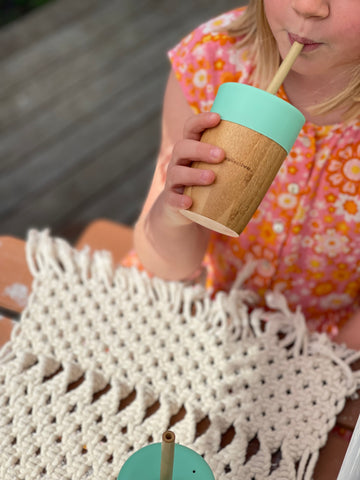
The bamboo parts of our products (the bowl, plate, cup and toothbrush handles) come from nature and will break down under the right conditions. Once moisture, heat, oxygen and microorganisms get to work, bamboo breaks down somewhere between 8 weeks and 3 years. A toothbrush handle, which has no glue, breaks down faster than a machine-made bowl, and cutting old bamboo into smaller pieces speeds things up.
Rather than throwing them out, you can reuse our bamboo products once your child grows out of them. Take the silicone off the sippy cup and it makes a great nut bowl, or snap the head off an old toothbrush and use the handle as a garden label!

What about the colourful 'bamboo fibre' products? You know the ones: they look like plastic and often have printed designs. It isn't straightforward, because of the mix of materials used to make them. Bamboo fibres on their own break down, but once they're mixed with things like melamine or epoxy resins, the result behaves much more like plastic.
When it comes to choosing sustainable products for my family, I live by what my Mumma used to say: 'There's good, better and best. Aim to do the best, but better is better than good!'